How to Own Your Narrative with Hannah Bronfman
If you've been creating content online for any length of time, you probably know the trap Hannah Bronfman is talking about. The need to show up polished, perfect, with everything following a neat linear timeline. It's exhausting. And after 13 years of building her career publicly—from DJ to wellness founder to investor—Hannah is finally breaking free from it.
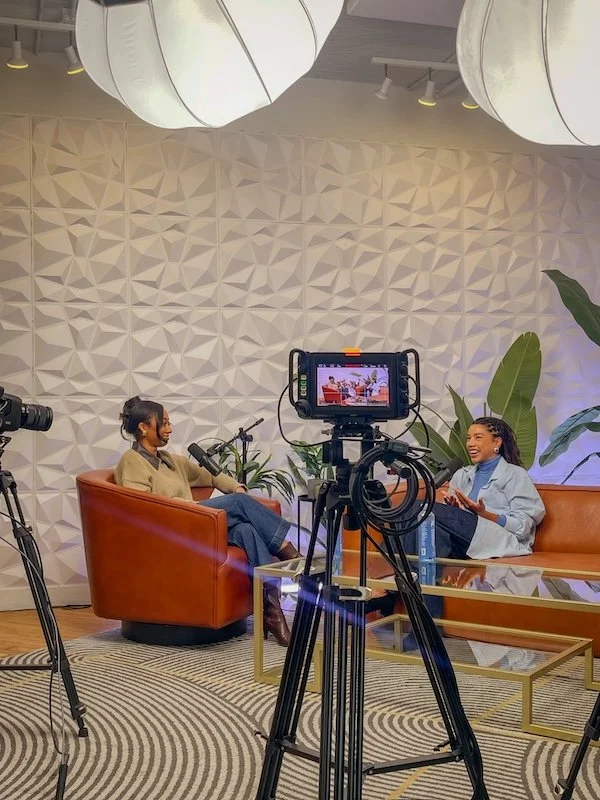
In this week's episode of She's So Lucky, Hannah and I get into the rules she's breaking in 2026, why the internet basically media trained millennials to perform perfection, and how an encounter with Paris Hilton at 18 changed everything she thought she knew about personal branding.
Here's what we talked about.
How to Free Yourself from Linear Timelines
Hannah started the conversation with a confession: she can't stop posting content in chronological order. It sounds like a small thing, but for her, it's become this limiting belief that holds her back from showing the full, messy reality of creating.
"It's like a millennial trap," she told me. "I just can't seem to break it. But I'm like, forget it. Who cares? No one knows the timeline except for me."
I actually think this is really relatable, especially for those of us who started creating content in the earlier days of social media. We were trained to show up a certain way—polished, linear, A then B then C then D. Hannah pointed out that being on the internet in our twenties basically media trained us, and for millennials especially, there was this extra pressure to show up perfectly.
Now she's trying to show the process over perfection. She doesn't want to hoard content in her camera roll anymore just because it doesn't fit some imaginary timeline. If it's evergreen, it can go out whenever. And honestly? That's freeing.
How to Diversify Your Content Strategy
Hannah is really intentional about how she shows up across platforms. She does two Substacks a week—one behind the paywall, one free—and uses them to recap her week, talk about pop culture, wellness, and whatever else is happening in her life.
On TikTok, she's trying to be as unfiltered as possible. Instagram is still part of the mix, but she finds it harder to post there on weekends when she's with her kids. Each platform serves a different purpose, and reaches a different audience.
"It's these intentional moments where I'm like, okay, how do I show up on all these platforms? What stories am I telling? How do I get people to come from different platforms over to this one?" she explained.
If you're building anything online, this is such an important thing to think about. You don't have to be everywhere, but you need to be thoughtful and intentional about the spaces you do choose to show up in.
Why You Should Ditch Your 5-Year Plan
One of my favorite parts of this conversation was hearing Hannah talk about how her career unfolded. Spoiler: she didn't have a five-year plan. She didn't know she was going to be a DJ, or a wellness founder, or an investor. None of it was mapped out.
"I didn't know where my life was going," she said. "And then all of a sudden my life was unfolding not just in front of me, but in front of everybody."
She left college, became a DJ, and social media came out at the same time. It helped her excel in her DJ career, which led to a fast-paced lifestyle—DJing around the world, traveling for gigs three or four times a week. After a while, the fast-paced lifestyle took its toll which led her to her wellness journey.
The lesson here? You don't have to have it all figured out. Sometimes the best career moves come from staying open and letting one door open another. Hannah's path proves that.
What Paris Hilton Taught Her About Personal Branding
In 2006, Hannah was working at Warner Music and got to do a walkthrough with Paris Hilton for the launch of her single "Stars Are Blind." What Hannah witnessed completely shifted how she thought about building a personal brand.
The Paris she met behind the scenes was nothing like her public persona. She was decisive. She was articulate. She had a completely different vocal tone. Hannah realized that Paris held so much power in controlling her own narrative.
"This whole Paris story has stayed with me for 20 years," Hannah told me. "I really was like, wow, she has so much power in being herself."
Paris was doing this before it was widely talked about. She created a character, controlled her narrative, and built an empire. That observation has influenced how Hannah approaches everything—from content creation to investing in other founders.
Opening Doors for Other People
One theme that kept coming up in our conversation was this idea of opening doors for other people. Hannah talked about how when she started DJing, there were literally five female DJs. She can name them. Now there are hundreds of thousands of female DJs killing it.
The same thing happened with wellness influencers and content creators. Hannah helped inspire a whole generation of people who wanted to live their lives on the internet.
"I think a part of the responsibility of living your life on the internet is opening doors for other people," she said. "While it might make my job a little bit more challenging today, it is what it is. And that's why you gotta keep evolving on your storytelling, evolving who you are."
That perspective is so important. Yes, more people in your space means more competition. But it also means you were part of something bigger. You helped create a movement. And if you keep evolving, you'll stay relevant.
What Founder-Friendly Investing Actually Looks Like
Hannah didn't plan to become an investor either. But after her own experience as a tech founder—including a co-founder breakup—she knew what it was like to need support. So when she started investing in other companies, she made a commitment to be hands-on and offer support to the founders she invested in beyond just cutting checks.
What does that actually mean? She shared a story about a founder who sent an email to her investors saying she was going through a co-founder fallout and would be the solo CEO moving forward. Hannah immediately wrote back offering to jump on a call.
"I wrote her back an email being like, ‘Hey, I totally know this feeling and where you're at and how emotionally draining this can be. I'm here. If you wanna jump on a call, talk through anything, let me know,’" Hannah shared.
They spent 90 minutes on the phone talking it through. And at the end of the call, the founder told Hannah she was the only person who responded to that email.
That relationship deepened to the point where Hannah has now done syndicates for her and brought other investors into the company. She's become a trusted advisor. All because she showed up when it mattered.
Investing in Women-Led Businesses
Hannah is also really intentional about investing in women-led businesses. The stats are bleak—women get roughly 2% of VC funding. So when Hannah invests, she doesn't just write a check. She forms syndicates to bring other investors to the table. She uses her network to open doors.
She invested in Golde, founded by Trinity Mouzon Wofford, and actively worked to get more capital to the company. That's what founder-friendly investing looks like. It's not just about the money—it's about showing up, using your platform, and being the kind of investor you wish you had.
The Rule Hannah Wants You to Break
At the end of our conversation, I asked Hannah what rule she thinks everyone should break in 2026. Her answer was simple but powerful:
"People should stop doing what they think they're supposed to do and start doing what they wanna do."
Period.
If you're feeling stuck trying to follow some predetermined path, take that as permission to stop. Follow your curiosity. Let one thing lead to the next. Your career doesn't have to look linear to be successful.
Final Thoughts
Talking to Hannah reminded me that the best careers aren't always the most planned ones. Sometimes you just have to stay open, keep evolving, and let one thing lead to the next. You don't need a five-year plan. You don't need to have it all figured out. You just need to keep showing up and being open to the possibilities in front of you.
And if you're building something, remember that opening doors for other people is part of the responsibility. Yes, it might make your job more challenging. But it also means you're the blueprint, and helped create a movement.
So whatever rule you think you're supposed to follow—the linear timeline, the polished persona, the five-year plan—maybe 2026 is the year you break it.
Listen to the full episode of She's So Lucky on Apple Podcasts, or Spotify. And if you're watching on YouTube, drop a comment below letting me know what rule you're breaking in 2026.