You Don't Need Millions to Start Angel Investing — Here's What You Actually Need
I have a confession: for a long time, I thought angel investing was for other people.
You know the type I mean — the Silicon Valley insider with a Rolodex full of Stanford founders and a casual $500K sitting around to deploy. Not for a girl from the podcast world who was still figuring out her own finances while building a media business from scratch.
And then I vocalized an interest in doing it, and Jaclyn Johnson reached out to help me get started.
Jaclyn is the founder behind Create & Cultivate, one of the most iconic brands built for ambitious women. She's also been angel investing since 2011 — before it was a personality trait, before it was a TikTok trend, before anyone was calling themselves an angel investor on their Instagram bio. She wrote her first check into Away Luggage for $10,000. Eight years later, she walked away with $1.2 million.
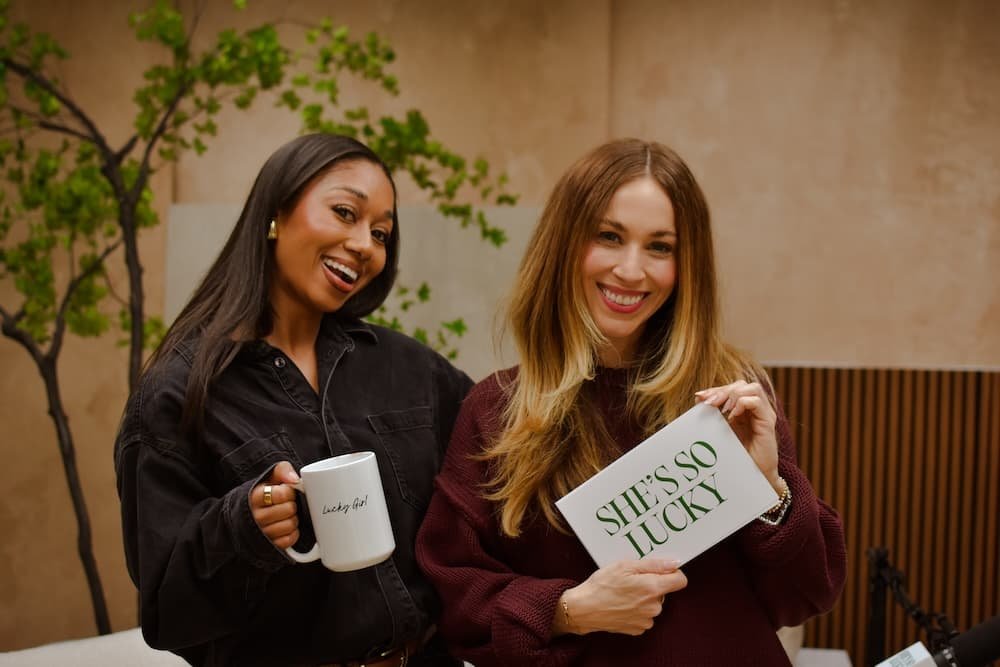
She came on She's So Lucky for the Lucky Girls Invest series and gave us a full masterclass on how angel investing actually works. I'm sharing the biggest lessons here because the more of us who understand this world, the better.
What Is Angel Investing, Really?
Let's start at the beginning, because the name is genuinely confusing.
Angel investing is not charity. The "angel" part just refers to the fact that you're often showing up for a company in its earliest, riskiest stage — before there's much proof, before there's much revenue, sometimes before there's even a finished product. You're betting on a founder and an idea.
The goal is still a financial return. You put money in early, and if the company grows and eventually gets acquired or goes public, you get a payout on your original investment. That payout can be small, it can be nothing, or — in cases like Jaclyn's Away investment — it can be life-changing.
The key difference between angel investing and venture capital is the structure. VCs raise money from limited partners (think: wealthy individuals, university endowments, institutions), pool it into a fund, and then deploy that fund according to a specific investment thesis. They need massive returns — we're talking 100x — because one giant win has to cover all their losses. That's why they're notoriously picky, intense, and fixated on unicorns.
Angel investors are different. You're investing your own money. You're not answering to a fund. You're not dependent on any single company's success. That changes everything about how you show up and why you do it.
As Jaclyn put it: venture capital is attracted to momentum, not the creator of it. Angel investing is where you get to be in the room before the momentum even starts.
How Jaclyn Johnson Turned $10,000 Into $1.2 Million
I want to tell this story properly, because the details matter.Jaclyn knew Jen Rubio (one of the co-founders of Away) through the New York creative and startup world. Jen was raising a friends and family round to launch what she described as "the Warby Parker for luggage." She mentioned she needed people who could write a $10,000 check.
Jaclyn said yes. Not because she had $10,000 sitting around — she didn't, but she believed in Jen. She wrote the check out of her business account, with her mom calling her to ask what on earth she was thinking. Fast forward eight years, and Away had raised hundreds of millions of dollars and scaled into a global brand.
Jaclyn received something called a tender offer — also known as a secondary — which is when a company buys back shares from early investors at a price higher than the current market value. She opened it on her phone, started doing the math on her calculator, and thought she was about to make $120,000.She called her lawyer and he told her she'd missed a zero.She was actually making $1.2 million.
She is the first person to tell you this is not the norm. Most angel investments don't return like this. Many return nothing at all. But it happened, and it proves the upside is real — especially when you invest in the right founder at the right time.
What Investors Are Actually Looking for in Founders
This is the part of our conversation that I keep coming back to.Jaclyn has now written a lot of checks. She knows within minutes whether a founder has what she's looking for. And it's not about the deck, the market size, or how well someone performs under the hot lights of a pitch competition.It comes down to two things.
Hunger. Are they showing up everywhere their business could possibly be? Are they relentless in a way that most people aren't? Jaclyn described herself during the Create & Cultivate years as a "relentless psycho" laser focused in a way that cost her sleep, her health, and some relationships. She's not saying that's the blueprint for everyone, but she is saying that kind of drive is what she's betting on when she writes a check.
Clarity on the exit. This is the one that surprises people. Jaclyn says most founders can’t clearly answer: who would buy your company, for how much, and why would they want to? That arc — from where you are now to who eventually acquires you — has to be part of how you think about your business from day one.
If a founder is fuzzy on this, it's a red flag, no matter how exciting the idea is.She's also very clear that she now only invests in companies she can actually speak to: businesses she understands, products she would use, industries she has context in. The investments she made out of FOMO, because a friend was doing a deal and she didn't want to miss out, are the ones she knows nothing about today. That's a data point worth internalizing.
The Truth About Women Founders and Venture Capital
We need to talk about this, because it's real and it's not going away by pretending it isn't there.Jaclyn made an observation that landed hard: women tend to come to fundraising rooms with what they think is possible. Men come with the impossible. And in venture capital, the impossible wins more often than it should.
There's a double standard in how ambition is received. Bad behavior — exaggerating, overpromising, doubling down — gets celebrated as passion when it comes from certain founders and called recklessness when it comes from others. Jaclyn pointed out the contrast between how quickly Adam Neumann raised again after WeWork imploded versus what would have happened if a woman founder had done the same.
Knowing this matters. Not because it means the game is unwinnable, but because you can't navigate a room you don't understand. And right now, more women are writing angel checks than ever before. Jaclyn noted that at the earliest stages of fundraising, women angel investors have actually surpassed VCs in total dollars deployed. That's the version of the story I want us to hold onto.
How to Actually Get Started With Angel Investing
If you're curious but don't know where to begin, here's what Jaclyn recommends:
Start with education, not a check. Even if you never plan to write an angel check, learning the vocabulary — valuations, dilution, secondaries, SAFEs, convertible notes — will change how you think about money and business. That knowledge compounds.
Get deal flow. Jaclyn co-founded Cherub, a platform designed to connect founders with angel investors in a more structured, accessible way. It's built specifically to solve the problem of angel investing being this informal, inside-baseball world where you have to know the right people to even hear about deals. If you want to explore deals, that's a good place to start — even just subscribing to their newsletter to get a feel for what's out there.
Consider co-investing. If a $10,000 minimum feels like a lot, Jaclyn mentioned that she's done deals where she and a friend created an LLC together and split the check — $5,000 each. It's a lower-risk way to get in the game and learn how the process works.
Know your diligence style. Some angel investors ask for a full data room before committing. Others wire money on instinct. Jaclyn herself is relatively light on diligence at the earliest stages mostly because when a company is that new, there isn't much to diligence. She focuses on a few core questions: Do you have a trademark? How much cash do you have in the bank? What does your exit look like?
The Lucky Girl Takeaway
At the end of our conversation, I asked Jaclyn about a belief around money that she thinks people need to unlearn.She said: "It is on the table. You just have to take it." The information, the access, the deals, the seats at tables that used to be closed — they're more available now than they have ever been.
Angel investing has been opened up. The platforms exist. The education exists. The community of women doing this together is growing every single day.The only thing that keeps most people out of the room is the belief that the room isn't for them.It is.
This post is inspired by Episode 343 of She's So Lucky: "You Don't Need Millions to Start Investing — Here's What You Need" featuring Jaclyn Johnson. Listen on Spotify, Apple Podcasts, or watch on YouTube. New episodes drop every Tuesday.
Disclaimer: Nothing in this post constitutes financial advice. Do your own research, talk to a financial professional, and invest only what you can afford to lose.