Visibility Won't Save You (Here's What Will)
We've been sold a very specific idea about success: that visibility is the key to everything. Post more. Show up more. Make sure the right people see you. Get loud, stay loud, and eventually, the right doors will open.
I used to believe that too.
But the more I've grown my own career, the more I've sat with really successful women, and honestly the more I've watched what happens to women who go all in on visibility as a strategy, the more I've started to question whether visibility is actually the goal we should be chasing.
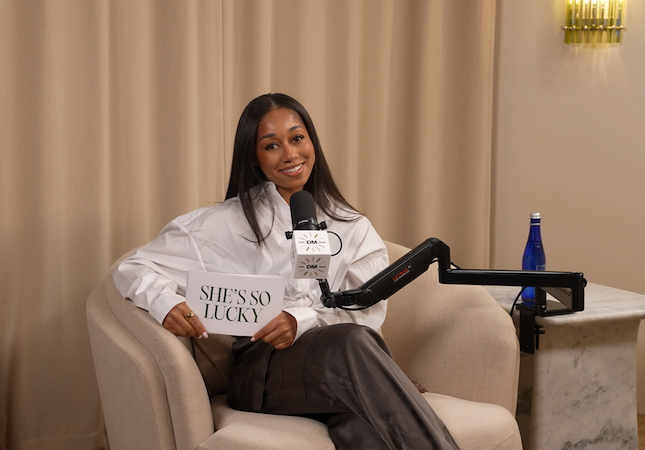
The short answer, at least for me, is no. And in Episode 349 of She's So Lucky, I get into why.
Visibility and Being Seen Are Not the Same Thing
This is the distinction that changed how I think about all of it.
Visibility, the way we talk about it in the career and content space, is about reach. It's about getting your name, your face, your message in front of as many people as possible. More followers, more press, more rooms, more eyes. The assumption is that more visibility equals more opportunity, which equals more success.
Being seen is something different. Being seen is about depth, not volume. It's about being understood by the people who actually need to receive what you have. When someone truly sees you, they get your message, they get where you're headed, and even when you stumble, they have context for it.
One of those things scales quickly and burns out just as fast. The other one builds something that actually lasts.
Why Being Seen Feels So Scary Right Now
I want to be honest about this because I think it gets glossed over in most conversations about visibility: the fear is legitimate.
We're living through a moment where everyone online feels like a potential critic. People are stressed and stretched and the way a lot of us are processing that is by going on social media and taking it out on someone who looks like they're doing okay. Everyday people, public figures, creators who've been building for years — nobody is exempt.
And if you're a woman, the bar is already uneven. If you're a woman of color, even more so. A small misstep that might earn a man a pass can follow a woman for years.
So wanting to shrink a little? That makes complete sense. But shrinking isn't really an option either, because at some point, getting what you want requires someone seeing you, understanding what you bring, and being in a position to act on it. The goal isn't to go invisible. It's to get strategic about who you're actually trying to reach.
When I stopped thinking about visibility as broadcasting to everyone and started thinking about it as being understood by the right people, the fear got a lot smaller. Because the people who are truly meant to receive your message are also the people who are most likely to extend grace when you're not perfect.
What Is a Post-Peak Pivot and Why Every Ambitious Woman Needs One
This is the part of the episode that I've been sitting with for a while, and it might be the most important thing I've said on the show this year.
A post-peak pivot is exactly what it sounds like: the intentional plan you make for what comes after you hit a major goal or milestone. The career peak. The project launch. The recognition moment. Whatever your version of the mountaintop looks like.
Most of us spend so much energy trying to get there that we haven't thought at all about what happens when we do. And here's the part nobody tells you: there is a very sharp cliff on the other side of that mountaintop. And if you don't have a plan, you will feel it.
We live in a culture that has a complicated relationship with successful women. It celebrates them up to a point, and then it turns. The same qualities that made her magnetic become grating. The hustle that got her here starts to read as try-hard. The longer she stays at that peak doing the same thing, the louder the criticism gets.
I've watched this happen to women I really respect. I've seen it play out in real time with public figures who hit an incredible moment and then just... kept going without adjusting. And I've also watched women who got to a peak and handled what came next with a lot of grace and intention.
Rihanna is the example I always come back to. She spent a decade as one of the biggest pop stars in the world, put out her best album, and then stepped back from music entirely. She didn't disappear. She built Fenty Beauty and Savage X Fenty, built a business empire worth more than anything her music career ever generated, and came back to music entirely on her own terms. That's a post-peak pivot. She didn't force the next thing because the internet was begging for it. She took the time to figure out what actually made sense.
Reese Witherspoon did the same thing after winning the Oscar. Instead of waiting for Hollywood to hand her roles that fit, she built Hello Sunshine, a production company centered on women's stories that she eventually sold for $900 million. The peak wasn't the Oscar. The peak was the empire she built after she stopped waiting for someone to hand her the next opportunity.
The lesson isn't that you disappear after your big moment. It's that you plan for it while you're still climbing, so that when you get there, you have somewhere intentional to land.
Not Everything Should Be Up for Consumption
There's a version of building in public that actually works against you, and I think it's worth naming directly.
When we post every hard moment, every business hiccup, every emotional low, we train our audience to come to us for that. And when your life inevitably gets better, those are often the people who leave. You've built a community around the mess, and the mess is no longer available.
There's also something quieter that happens over time, which is that it erodes people's trust in your ability to figure things out. Not because they're being cruel, but because you've shown them mostly the problems and not enough of the solutions.
Sharing hard things isn't the issue. Being human and honest is one of the most powerful things you can do. But there's a real difference between vulnerability that connects and over-sharing that performs. The first one usually comes after you've worked through something and have something real to offer. The second one is reaching for a quick reaction, and it tends to attract people who are there for the chaos, not for you.
The Real Power Move
Here's the reframe that ties all of this together for me.
The power is not in other people seeing you. The power is in you being willing to let people see your magic.
That shift might sound subtle, but it changes everything about how you show up. Chasing visibility is an outward reach. It's dependent on who notices, who responds, who decides to open the door. It gives your power to the audience, to the algorithm, to the gatekeepers.
Being willing to let people see your magic is entirely different. It's rooted. It starts from a place of knowing who you are and what you bring, and trusting that when the right people encounter it, it's going to land. You're not performing for everyone. You're showing up fully for the people who it's actually for.
That is what creating your own luck looks like when it comes to visibility. Not louder. Not more. More intentional, more rooted, and more honest about who you're actually trying to reach.
Episode 349 of She's So Lucky is out now. Listen on Spotify, Apple Podcasts, or YouTube.